What is EPIC OpTime?
EPIC OpTime is one of the most popular surgery management solutions and is commonly used as an OR and Procedural Rooms system – as the main EHR software. EPIC’s EHR is the market leader in the US with nearly a third of US hospitals using this software.
The EPIC OpTime software is an operating room management system that follows perioperative workflows including scheduling, medical records, pre and post operative patient assessments, as well as procedural records.
Why does EPIC OpTime use third party solutions?
Like many systems, it often works better with specialist third-party add-ons that perform tasks that complement are not successfully performed using the main software. This integration of third-party software enhances the functionality of the EPIC OpTime system.
How does Epic integration work?
EPIC integration facilitates the data exchange between EPIC’s system and other software platforms. This means that EPIC can transfer data to third party systems or vice versa.
EPIC is a cloud-based system, so can be easily integrated with other third-party systems and applications. By doing this EPIC is able to consolidate electronic data from multiple sources.
One thing to look out for when considering EPIC OpTime add-ons is that the additional software follows HL7 compliance. HL7 is a set of clinical standards and formats that provide a framework for healthcare data exchange between two systems.
When EPIC and the additional software both follow HL7 standards it makes the integration between both systems easier.
The benefits of EPIC OpTime integration for healthcare providers
Increasingly, business systems are being integrated within clinical systems to ensure the smooth flow of data across healthcare software. This will ensure that data feeds into processes such as medical billing, scheduling and more.
The integration of EHR systems such as EPIC OpTime and third-party software enhances the interoperability of the healthcare provider, ensuring that internal workflows receive prompt and accurate information, without the need for duplicate data entry, which is a risk to data integrity.
The data generated across the hospital is not just about hospital operational efficiency, it also aids management decision making in terms of the provision of care, the allocation of budgets, the planning of staffing requirements, and the forecasting of future demand, to name just a few.
Charge capture in healthcare using EPIC OpTime
Charge capture is a crucial element of healthcare revenue cycle management which directly affects healthcare financial performance. This key workflow ensures that the healthcare organization receives full payment for the services provided. Charge capture includes several stages, including the documentation and posting of items, and ensuring the reconciliation of all charges incurred during the patient’s treatment. The US reimbursement process is complex and relies upon prompt, complete and correct claim submissions.
The EPIC system uses automated charge capture workflows as well as manual charge capture processes to log the cost elements of each care. The EPIC Charge Router processes all chargeable events during the patient’s treatment, including costs incurred in the Operating Room.
OpTime’s intraoperative record documents charge capture of the products used in surgery, plus other chargeables such as lab tests, diagnostic services, pharmacy costs and more. All of these items are captured in disparate systems across the organization, but also need to be captured in EPIC.
Weak point of EPIC Charge Capture
EPIC charge capture is well-equipped to process charges and item data but for some areas of the organization, capturing that data is problematic.
The point of care is a known weak spot for comprehensive data collection. It is not uncommon for there to be gaps in charting with EPIC OpTime, due to complications collecting all required data on reportable items. Collecting surgical item and charge capture in EPIC OpTime relies on manual application.
During surgery, as part of the perioperative processes, the nurse needs to ensure that the intraoperative charting system is updated with every consumed and reportable item. However, inadequate systems for perioperative documentation data collection, such as barcode scanning and manual inputting, make this an extremely difficult task.
Manual keying in of data into the EPIC system involves multiple screens and fields plus dropdowns and pop-ups. The nurse may not be sure which option to select in these instances and this can potentially result in uncaptured charges and lost revenue.
In order to be able to reconcile 100% of charges through the charting in EPIC, a system add-on is beneficial, ensuring full and accurate data collection takes place. If surgical data is incomplete or incorrect, these inaccuracies will impact on the reimbursement received, which will affect the financial performance of the healthcare organization.
How to give Epic OpTime documentation superpowers
EPIC with an integrated third-party solution for enhanced surgical supply data collection, leads to more robust charting and charge capture.
Traditional systems such as barcode scanning have proven to be unreliable in the complex OR and procedural room settings. Many items end up with data gaps or are still not included in the patient file at the end of surgery.
IDENTI is offering a brand-new approach to surgical consumption data capture, by leveraging advanced technology such as image recognition, artificial intelligence, machine learning and data insights.
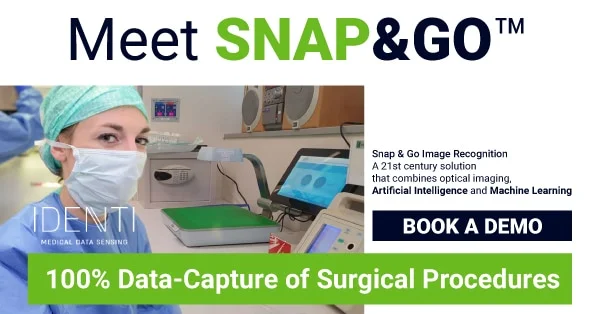
Snap&Go automates the tasks of capturing and recording surgical product usage, by using a computer vision sensor. This takes a quick ‘snap’ of product packaging. The nurse simply places the packet or label under the camera and the system ‘reads’ the image and converts it into digital data.
The item data is then automatically identified via a global SKU database that acts like a virtual item master for providers.
Finally, seamless integration with EPIC OpTime makes sure all that valuable surgical consumption data collected is shared with the EHR, ERP, and MMIS.

The benefit of EPIC OpTime plus Snap&Go
The combination of EPIC EHR software and Snap&Go increase nurse capacity and productivity, while improving the efficiency and accurate of surgical supply data collection.
The efficient data sharing of surgical supply chain data with operational workflows delivers the following benefits:
- 100% item and surgical supply charge capture
- Optimized medical billing and reimbursement
- Reduced nurse supply chain administration improves the quality of patient care
- Full EHR records ensure legal, regulatory and standards compliance
- Enhanced implant recall management
- Data-driven procurement and accurate data to support leaner inventory management
- Vital healthcare business intelligence to drive through healthcare planning, forecasting and management.
EPIC Optime is an established operating room management system that can achieve enhanced surgical supply documentation by the integration of Snap&Go. This winning combination results in full and accurate intraoperative records while at the same time reducing the administrative burden on nurses.
The seamless capture and processing of surgical supply data supports organization-wide operational and management activities and safeguards patients. Ultimately, by addressing a weak point in surgical data capture, the organization is able to optimize clinical, operational and financial performance.
Do you use EPIC OpTime, but wish that your OR data capture was more efficient? Contact us to discuss the benefit of our simple-to-integrate software.