
Hospitals depend on the operating room (OR) to drive revenue, yet OR inventory remains one of the least visible parts of the enterprise. Even well-run organizations struggle to answer the foundational questions: What stock do we actually have? What was used during a case? Was it billed? What expired without anyone noticing?
These gaps are especially pronounced, with consignment, bill-only items, and vendor-managed stock; three categories that move quickly, bypass standard workflows, and introduce complexity into inventory tracking.
When documentation depends on memory or manual tasks inside a fast-moving OR environment, blind spots multiply. That’s where financial leakage begins: incomplete case costing, missed implant charges, inaccurate inventory levels, and contracting decisions based on partial data. As margins tighten across the industry, these blind spots have become too costly to ignore.
OR Inventory Blind Spots Undermine Margin
Most hospitals would say they have perpetual OR inventory. But in practice, inventory management is still a patchwork of barcode workflows, spreadsheets, static preference cards, and manual reconciliation. High-value implants and biologics move quickly, and often never pass through the storeroom, creating significant visibility challenges.
Where OR Inventory Visibility Breaks Down
The most persistent OR inventory blind spots arise when items bypass the ERP entirely or in the moment focus more on patient care than documentation processes. For example:
- Consignment implants sit in the OR without validated counts.
- Bill-only items may not appear in the item master.
- Trunk stock arrives with a rep and disappears the same day.
Across hospitals, this results in the same familiar pattern: counts that don’t match reality, inaccurate case costs, and reconciliation efforts that drain hours without producing trustworthy data. This combination creates ongoing operational and financial risk.
Blind Spots Across the Hospital Value Chain
Even a single undocumented implant or missing biologic affects multiple teams. Our infographic outlines the cross-functional chase to recover missing charges, while the table below highlights the broader strategic impact.
How OR Inventory Blind Spots Impact Each Department
| Department | Hidden Impact of OR Inventory Gaps |
|---|---|
| Finance / CFO | Inaccurate OR inventory valuation; understated write-offs; missed implant revenue |
| Supply Chain | Poor OR demand forecasting; weak vendor leverage; inflated par and safety stock |
| Perioperative Leadership | Case delays; unreliable OR preference cards; inefficient planning and scheduling |
| Revenue Cycle | Missed charges; time-consuming reconciliation; slower, more complex reimbursement |
| Quality & Compliance | UDI traceability gaps; recall risk; undetected expired consignment and biologics |
What may appear to be “just an OR inventory issue” often becomes a barrier to financial, operational, and clinical performance across the entire hospital.
How Can Hospitals Improve OR Inventory Accuracy With AI?
Hospitals are increasingly turning to AI-powered documentation and automated data capture to close OR inventory gaps. These solutions transform surgical inventory management from a manual, retrospective process into a real-time, verified, and accountable one.
AI Charge Capture at the Point of Use
Computer vision and machine learning solutions like Snap&Go capture and record implant and supply usage at the point of use. By converting images into structured data, AI accurately captures UDI, lot, serial number, and expiration – even for items not listed in the item master. This camera-based approach adds visual proof of use, providing reliable documentation for billing, costing, and compliance.
Smart Cabinets and RFID for High-Value Stock
Total Sense RFID Smart Cabinets monitor implants and biologics continuously, providing real-time OR inventory visibility without manual scanning. This brings consignment inventory into the same data ecosystem as owned stock, allowing hospitals to see what is present, what has moved, and what is nearing expiration.
Seamless Integration with Clinical and Financial Systems
Verified usage data flows from the AI-powered IDENTIPlatform directly into the EHR, ERP, and revenue cycle systems, closing gaps in OR charge capture and case costing. Leadership gains confidence in what was used, what was billed, and what needs to be replenished.
Data That Predicts Demand
Once usage is reliably captured, AI can forecast demand, identify variation, and optimize par levels. Preference cards, replenishment cycles, and vendor negotiations all become grounded in accurate consumption data rather than estimates.
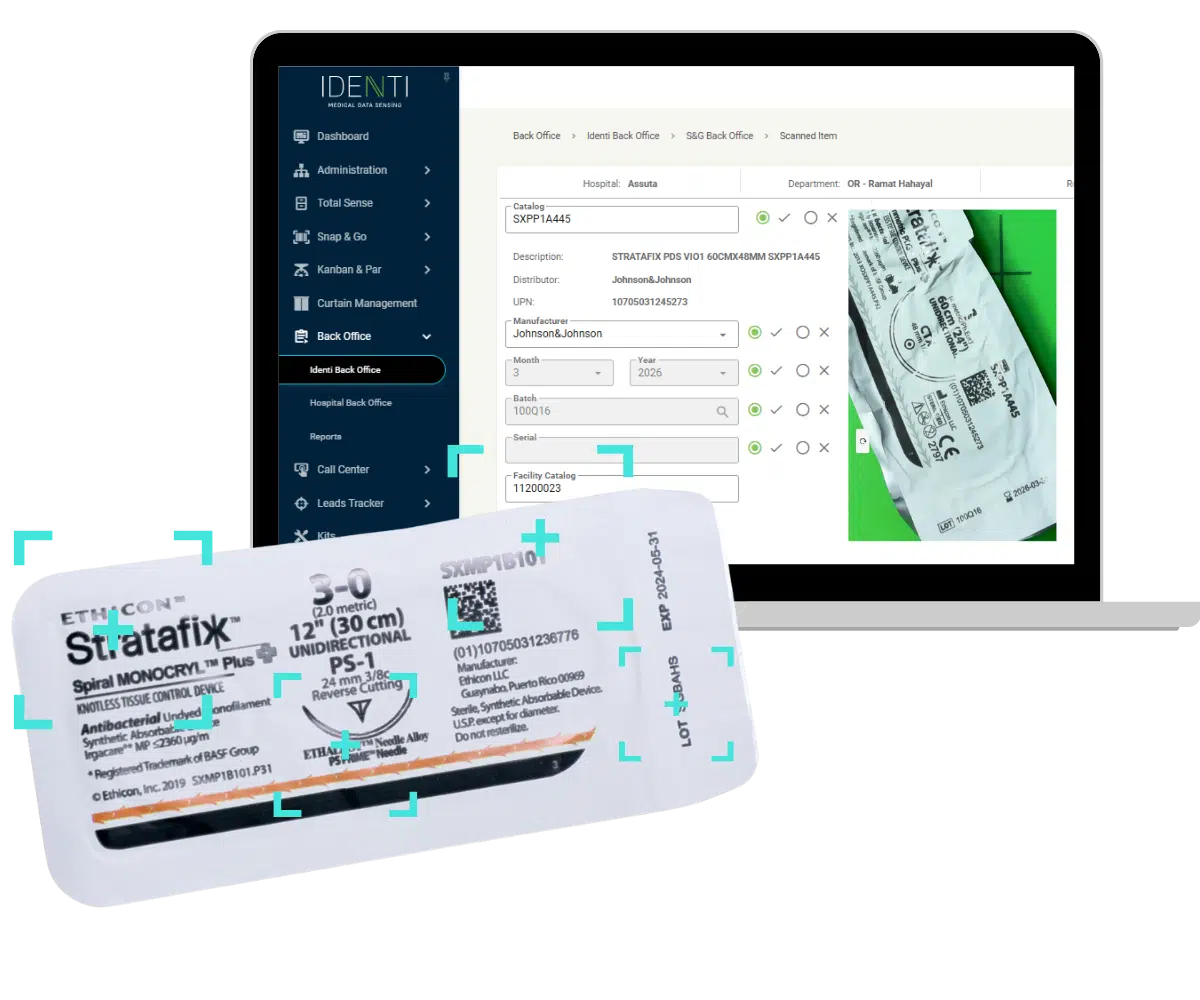
How AI Changes Daily Operations
AI introduces a closed-loop workflow that eliminates manual steps and ensures accurate, real-time visibility from the moment items enter the OR.
When an implant, biologic, or supply arrives, it is automatically tracked. During the case, AI captures usage in real time and sends documentation into the surgical record before the case closes. Supply levels update instantly, preventing stockouts and reducing over-ordering.
Because the data is clean and complete, leadership can plan proactively rather than reactively. This shift reduces documentation burden for nurses, strengthens supply chain forecasting, and gives finance reliable insight into inventory usage with no additional labor.
Turning Better Visibility into Margin Protection
Hospitals that close OR inventory blind spots typically see rapid improvements across charge capture, waste reduction, supply cost management, and OR efficiency. AI-powered OR inventory visibility stops hidden margin leakage and helps hospitals move from reactive to proactive management.
- Better Visibility Improves Revenue: When every implant and high-cost item is captured accurately, revenue cycle performance improves. The hospital stops losing income from undocumented bill-only items, and payer documentation becomes cleaner and more compliant.
- Automation Reduces Waste: Real-time tracking significantly decreases expired consignment and biologics. Automated expiration monitoring replaces manual checks and prevents costly write-offs.
- Data: Lower Supply Costs: Accurate usage patterns allow supply chain teams to reduce excess inventory and negotiate more effectively. Consignment levels can be calibrated to actual demand instead of guesswork.
- Accuracy Improve OR Operations: Fewer case delays, more accurate preference cards, and reduced manual documentation create smoother clinical workflows. OR leaders gain visibility into true utilization and can plan more effectively.
Why OR Inventory Visibility Matters More Than Ever
OR inventory blind spots are not a staffing issue; they are a systems issue. Manual processes cannot keep up with the speed and complexity of modern surgical care, especially when high-value implants, consignment products, and bill-only items move in and out of the OR so quickly without standardized tracking.
AI and automation give hospitals something transformational: real-time, end-to-end clarity of surgical supply usage. The result is cleaner data, stronger financial performance, reduced waste, and a more resilient supply chain.
As margins tighten across the industry, fixing OR inventory blind spots has become one of the most strategic and impactful steps a hospital can take.
Want to learn more? Schedule a demo to see what your OR inventory data has been missing.